- +44 7932 089286

Wealth Builders Blueprint 1 Section6 Lessons3 Hours
Lesson 5: Build with Structure
Lesson 5: Build With Structure
Welcome to Lesson 5
Many people can start. Very few can sustain.
The difference between builders who finish and builders who collapse is almost never talent, opportunity, or even resources. It is structure.
Structure is what protects growth. Structure is what keeps a business alive when the founder is tired. Structure is what ensures that wealth created in one generation does not disappear in the next.
And equally important — knowing the pitfalls before you reach them is what keeps you on track when everyone else is falling off.
Part 1 — Building With Structure
Financial Structure
Financial structure is the system you put around your money so it works for you even when you are not actively managing it. It includes:
• A budget that reflects your values and your vision — not just your bills
• A cash flow system that tracks money coming in and going out
• An emergency reserve — ideally 3 to 6 months of living expenses
• Protection — insurance, wills, and legal structures that preserve what you build
• Investment — money working and growing beyond your active income
Most people manage money reactively — responding to what has already happened. Structure allows you to manage money proactively — directing where it goes before it arrives.
Systems Thinking
A system is a repeatable process that produces consistent results. Wealthy builders do not rely on motivation — they build systems. Systems run even when motivation runs out.
Ask yourself:
• Do I have a system for saving — or do I save whatever is left?
• Do I have a system for tracking income and expenses — or do I guess?
• Do I have a system for growing my skills — or do I learn randomly?
• Do I have a system for protecting my health — or do I manage it in crisis?
Where you have no system, you have no consistency. And without consistency, you cannot build.
Time as a Wealth Asset
Time is your most non-renewable resource. Every wealth builder must learn to audit, protect, and invest their time with the same intentionality they apply to money.
A time audit is simple — track where your time actually goes for one week. Most people are shocked by what they find. The goal is to align your time with your vision — not just your immediate demands.
Part 2 — Biblical Case Studies on Structure
Many people pray for increase, but increase without structure becomes a burden. God often answers prayer by giving us systems rather than miracles. Miracles may start something, but structure sustains it.”
Theme: Structure Determines Sustainability
A gift can open a door.
A vision can inspire people.
A prophecy can reveal the future.
But only structure can sustain what God builds.
Everything God intended to last was built with order.
“For God is not the author of confusion but of peace…” (1 Corinthians 14:33)
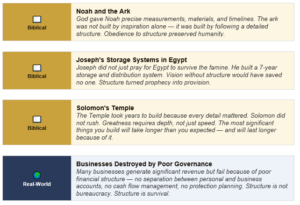
1. Noah’s Ark – Structure Preserves Purpose
Biblical Principle
God never simply said,
“Noah, build something that floats.”
He gave:
- exact measurements
- exact materials
- exact compartments
- exact timing
- exact instructions
Every measurement mattered.
Humanity survived because Noah followed God’s structure.
Obedience to structure became preservation for generations.
Psychological Principle
People often mistake passion for preparation.
Psychologists call this the Planning Fallacy.
People consistently underestimate:
- time
- resources
- complexity
Without a detailed plan, people rely on emotion.
Structure reduces anxiety because it creates certainty.
The brain performs better when expectations are clear.
Practical Application
Family
Children flourish with:
- routines
- boundaries
- predictable consequences
- shared values
Love without structure creates insecurity.
Business
Every business needs:
- SOPs (Standard Operating Procedures)
- financial systems
- customer journey
- documented processes
Otherwise every problem comes back to the founder.
Ministry
Many ministries grow quickly…
…then collapse because everything depends on one person.
Healthy ministry creates:
- leaders
- teams
- accountability
- succession
Key Quote
Structure doesn’t limit freedom—it protects purpose.
2. Joseph’s Storage System – Structure Creates Capacity
Biblical Principle
Joseph interpreted Pharaoh’s dream.
But interpretation wasn’t enough.
He designed:
- collection systems
- storage facilities
- taxation
- distribution
- logistics
Vision alone would never have saved Egypt.
Systems did.
The miracle was not the dream.
The miracle was the administration.
Psychological Principle
Executive function research shows that successful people reduce decision fatigue through systems.
Successful people don’t rely on memory.
They build systems.
Systems outperform motivation.
Practical Application
Family
Don’t simply hope your children learn about money.
Create systems:
- weekly saving
- family budgeting
- family meetings
- chores
- investing together
Culture is created by repeated systems.
Career
Successful professionals develop:
- daily routines
- learning schedules
- networking habits
- performance reviews
Promotion usually follows consistency.
Business
Don’t chase more customers if your systems cannot handle them.
Growth magnifies weaknesses.
Structure allows scale.
Ministry
Prayer meetings
Volunteer rotas
Discipleship pathways
Follow-up systems
Leadership development
These are not administrative tasks.
They are ministry.
Key Quote
Systems turn inspiration into multiplication.
3. Solomon’s Temple – Structure Builds Excellence
Biblical Principle
The Temple wasn’t rushed.
Every stone.
Every measurement.
Every craftsman.
Every material.
Everything reflected God’s excellence.
It took years because significance cannot be rushed.
The Temple lasted generations because excellence was built into its structure.
Psychological Principle
Modern psychology calls this Delayed Gratification.
High performers sacrifice immediate comfort for long-term significance.
They understand:
Fast is exciting.
Deep is transformational.
Practical Application
Family
Strong marriages aren’t built in one weekend retreat.
They’re built over years of:
- forgiveness
- communication
- trust
- consistency
Career
Mastery takes deliberate practice.
People admire the result.
They rarely appreciate the years of structure behind it.
Business
Everyone wants six figures.
Few want:
- bookkeeping
- compliance
- HR
- documentation
- strategic planning
- Legal structure and adequate cover
Yet those are the things that keep six figures.
Ministry
Don’t pursue crowds.
Build disciples.
Don’t pursue platforms.
Build character.
Character is ministry’s structural foundation.
Key Quote
Greatness grows slowly because depth cannot be microwaved.
4. Businesses Destroyed by Poor Governance
Biblical Principle
Throughout Scripture, stewardship always precedes increase.
Jesus repeatedly taught:
“If you have been faithful with little…”
Faithfulness is demonstrated through stewardship.
Stewardship requires governance.
Psychological Principle
Behavioural economists describe a common bias known as present bias—people prioritise today’s gratification over tomorrow’s security.
Without governance, even talented people drift into reactive decisions rather than intentional ones.
Practical Application
Many businesses fail because owners never separate:
Personal money
Business money
Identity
Responsibilities
Decision making
Governance includes:
- financial reports
- budgets
- board meetings
- accountability
- legal compliance
- insurance
- succession planning
- documented procedures
Structure is what allows a business to outlive its founder.
Family Governance
Every family should have:
- a family vision
- a monthly budget
- wills
- life insurance
- emergency fund
- shared values
- regular family meetings
Healthy families don’t happen accidentally.
They are intentionally led.
Career Governance
Govern your career by having:
- annual goals
- a mentor
- continuous learning
- regular feedback
- measurable progress
Don’t drift through your career.
Direct it.
Ministry Governance
Healthy ministry requires:
- financial transparency
- safeguarding
- accountability
- leadership succession
- clear doctrine
- pastoral care structures
Anointing attracts people.
Governance protects them.
The Four Pillars of Structure
| Case Study | What It Teaches | Modern Application |
|---|---|---|
| Noah | Structure preserves life | Build clear foundations before expansion |
| Joseph | Systems create capacity | Design processes that allow sustainable growth |
| Solomon | Excellence takes time | Pursue depth over speed |
| Governance | Stewardship sustains increase | Lead with accountability and long-term thinking |
Closing Challenge
“Many people ask God for another level, but another level requires another structure. A two-bedroom house cannot hold a family of ten. A notebook cannot manage a multinational business. A gifted individual cannot carry a global ministry alone. Every increase from God demands a corresponding increase in structure. The question is not whether God wants to bless you—the question is whether your current structure can sustain the blessing you’re praying for.”
Key Takeaway: Vision gives direction. Identity gives confidence. But structure gives longevity. Families, careers, businesses and ministries become multigenerational not because they had the greatest ideas, but because they built the systems that allowed those ideas to endure.
Part 3 — Navigating Pitfalls and Mistakes
Every builder will face pitfalls. The goal is not to avoid all mistakes — it is to recognise the most common ones before they find you, and to recover well when they do.
The Most Common Pitfalls
• Wrong partnerships — building with people whose values, work ethic, or vision do not align with yours
• Lifestyle inflation — increasing spending every time income increases, leaving no room to build
• Emotional spending — using money to manage feelings rather than build futures
• Poor due diligence — making decisions without adequate research or counsel
• Comparison — measuring your chapter 3 against someone else’s chapter 20
• Perfectionism — waiting until everything is perfect before you begin or release
• Burnout — building without rest until the builder collapses with the building
• Ego and pride — stopping listening, stopping learning, stopping being accountable
The Most Important Thing About Failure
Many people never rebuild after failure because of shame. They made one mistake — a bad investment, a failed business, a financial decision that cost them everything — and they decided that mistake defined them.
It does not.

Failure Is Information, Not Identity
The Big Idea
Failure is not a verdict.
It is feedback.
One bad decision does not make you a failure any more than one good decision makes you a success.
Your identity is found in who God says you are—not in your latest result.
“Though the righteous fall seven times, they rise again…” (Proverbs 24:16)
Notice the righteous still fall.
What distinguishes them is that they rise.
Peter – Failure Was Not the End
Biblical Principle
Peter denied Jesus three times.
Imagine the shame.
He had publicly declared,
“Even if everyone else falls away, I never will.”
Yet only hours later, he denied even knowing Christ.
If Peter had allowed shame to define him, Pentecost would never have happened.
Instead…
Jesus restored him.
“Do you love me?”
“Feed my sheep.”
The very man who failed publicly became the man who preached publicly, leading thousands to Christ.
Failure became part of his testimony, not his identity.
Psychological Principle
Psychologist Dr. Carol Dweck describes the difference between a fixed mindset and a growth mindset.
A fixed mindset says:
“I failed… therefore I am a failure.”
A growth mindset says:
“I failed… therefore I learned something.”
Builders ask:
“What is this experience teaching me that success never could?”
Shame vs Conviction
One of Satan’s greatest weapons is shame.
Shame says:
- You are finished.
- You always mess things up.
- You’ll never recover.
- People will never trust you again.
The Holy Spirit brings conviction instead.
Conviction says:
- That decision was wrong.
- Learn from it.
- Repent where necessary.
- Get back up.
- Build differently.
Shame pushes you away from God.
Grace draws you back to Him.
Wealth Builder Application
Every wealth builder will experience setbacks.
Perhaps you:
- bought the wrong property
- trusted the wrong business partner
- accumulated debt
- made a poor investment
- lost money in business
- missed an opportunity
Those experiences become expensive if you learn nothing.
They become valuable if they teach you wisdom.
Some of your greatest assets will be the lessons you paid dearly to learn.
The Wealth Builder Reflection
Instead of asking:
“Why did this happen to me?”
Ask:
- What was I assuming?
- What warning signs did I ignore?
- What skill was I missing?
- What system needs improving?
- What would I do differently next time?
Failure is tuition.
Make sure you graduate.
Rebuild Better
When Peter was restored, Jesus didn’t merely put him back where he was.
He rebuilt him into someone stronger.
The same is true for us.
Failure should produce:
- greater humility
- stronger discernment
- better systems
- wiser relationships
- deeper dependence on God
Don’t rebuild the same life.
Rebuild a wiser one.
Closing Challenge
“Some people spend the rest of their lives trying to hide their failures. Wise builders examine them, learn from them, and use them as stepping stones. The greatest tragedy is not that you failed. The greatest tragedy is allowing one moment of failure to stop the purpose God still has for your life. Peter’s denial was one chapter—not the whole book. Neither is yours.”
Key Takeaway: Failure is an event, not an identity. Every setback contains data. Extract the lesson, embrace God’s grace, make the necessary changes, and keep building. The builders who leave the greatest legacy are rarely those who never fell—they are those who refused to stay down.
Part 4 — Real-World Case Studies on Pitfalls

“The higher God takes you, the greater the need for wisdom. The enemy often cannot stop your calling, but he will try to exploit your blind spots. Every builder must learn not only how to build, but how to protect what they build.”
Theme: The Pitfalls Every Builder Must Avoid
1. Samson – Gift Without Discipline
Samson possessed supernatural strength, but his greatest weakness wasn’t physical—it was internal.
His downfall came through:
- poor boundaries
- impulsive decisions
- unhealthy relationships
- believing his gifting would always protect him
Eventually his gift could no longer compensate for his lack of character.
Talent may open doors, but character determines how long you stay in the room.
Luke 16:10 – “Whoever can be trusted with very little can also be trusted with much.”
This reflects overconfidence bias—the tendency to believe our strengths make us immune to failure.
High performers often think:
- “That could never happen to me.”
- “I can handle it.”
Without accountability, blind spots become vulnerabilities.
Protect your:
- character
- marriage
- friendships
- reputation
- health
- spiritual life
Never become so gifted that you stop being teachable.
2. Saul – Comparison Kills Calling
Saul’s greatest enemy wasn’t David.
It was insecurity.
He became obsessed with protecting his position instead of fulfilling his purpose.
Comparison led to:
- jealousy
- fear
- poor decisions
- loss of focus
When you compare your assignment with someone else’s, you stop stewarding your own.
Galatians 6:4-5 encourages each person to evaluate their own work rather than measuring themselves against others.
Psychologists call this social comparison theory.
Constant comparison produces:
- anxiety
- envy
- low confidence
- poor decision-making
People who compare constantly struggle to celebrate others’ success.
Celebrate other people’s wins.
Run your race.
Stay focused on your lane.
Success isn’t about being ahead of everyone else.
It’s about becoming everything God created you to be.
3. Athletes Who Lose Their Fortunes
Many elite athletes earn millions during their careers, yet a significant number experience serious financial difficulties within a few years of retirement.
The common reasons include:
- lifestyle inflation
- poor financial advice
- lack of budgeting
- no investment strategy
- failure to prepare for life after sport
Income alone does not create wealth.
Stewardship does.
Behavioural economists describe lifestyle creep—as income increases, spending often rises just as quickly.
Without intentional financial habits, higher earnings simply support a more expensive lifestyle.
Increase investments before increasing lifestyle.
Build assets.
Plan beyond today’s income.
Remember:
Money is a wonderful servant but a terrible master.
4. Entrepreneurs Who Scale Too Quickly
Real-World Principle
Many businesses don’t fail because demand disappears.
They fail because growth outpaces their systems.
Common mistakes include:
- hiring too quickly
- poor cash flow management
- inadequate processes
- weak leadership structures
- founder burnout
Growth without infrastructure creates instability.
Psychological Insight
This is often driven by optimism bias—the belief that future success will solve today’s structural problems.
Wise builders strengthen the foundations before adding more weight.
Practical Wealth Builder Lessons
Ask before every new opportunity:
- Can our systems handle this?
- Do we have the cash flow?
- Do we have the right people?
- Can we sustain this over the long term?
Sometimes the wisest decision is to strengthen before expanding.
Wealth Builder Protection Checklist
Encourage your audience to regularly ask themselves:
Guard Your Character
- Am I becoming more humble as I become more successful?
- Who has permission to challenge me?
Guard Your Calling
- Am I comparing myself to others?
- Am I staying faithful to my assignment?
Guard Your Wealth
- Is my spending increasing faster than my assets?
- Am I building wealth or simply appearing wealthy?
Guard Your Business
- Are my systems keeping pace with my growth?
- Would my business function if I stepped away for two weeks?
Guard Your Soul
- Am I still making time for God, family and rest?
- Am I building success at the expense of the people I love?
Key Takeaway
Every builder has three responsibilities:
Build wisely.
Guard diligently.
Finish faithfully.
Many people know how to start. Fewer know how to sustain. The builders who leave a lasting legacy are those who understand that wealth, influence, business, family and ministry are not only gifts to be received—they are responsibilities to be stewarded. As Proverbs 4:23 reminds us, “Above all else, guard your heart, for everything you do flows from it.” Guard the inner life, and you greatly increase the likelihood that what you build will endure.
LESSON 5 REFLECTION
Take a few minutes to answer these questions honestly:
1. Where in your financial life do you have no system — and what is the cost of that?
2. Which of the common pitfalls listed above do you recognise most in your own journey?
3. Is there a past failure or mistake you are still carrying shame about? What would it look like to release the shame and keep the lesson?
Write your answers in your journal.
YOUR NEXT STEP AFTER THIS LESSON
The financial structure and systems thinking in this lesson are covered in full depth across
Modules 3, 4, and 5 of the Broad Place Financial Blueprint.
From cash flow and budgeting to income streams, property, and investment —
the Blueprint gives you the complete practical framework to build with structure.
When you are ready: Classroom → The Broad Place Financial Blueprint → Module 1, Lesson 1.
When you have finished this lesson — click the Mark as Done button at the top right to track your progress and move to the next lesson!