- +44 7932 089286
Wealth Builders Blueprint 1 Section6 Lessons3 Hours
Lesson 4: Reset Your Blueprint
Welcome to Lesson 4
Before you can build something new, you have to deal with what was built before you — and sometimes what was built inside you.
Many people try to build wealth, businesses, and legacies on foundations that were never properly laid. They wonder why things keep collapsing. The answer is almost always in the blueprint — the internal blueprint they were handed, absorbed, or inherited without choosing it.
This lesson is about resetting that blueprint. Identifying what needs to be healed, released, and rebuilt — so that everything you build from here stands.
Part 1 — The Corrupted Blueprint
Every person carries a blueprint — a set of beliefs, patterns, and behaviours around identity, money, relationships, and success. Some of that blueprint was given to us by our families. Some was shaped by our experiences. Some was inherited across generations without anyone choosing it.
A corrupted blueprint does not mean you are broken. It means something needs to be identified, named, and rebuilt.
Generational Patterns
Generational patterns are behaviours and beliefs that repeat across families without anyone deliberately choosing them. They can be financial — like always struggling with money no matter how much you earn. They can be relational — like cycles of abandonment or control. They can be spiritual — like a family that has never fully trusted God with finances.
Until a pattern is named it cannot be broken. The first step of resetting your blueprint is identifying which patterns you inherited.
Trauma and Money
Financial trauma is real. It is the emotional wound left behind by experiences of lack, loss, financial abuse, or sudden wealth. It shapes how you spend, save, invest, and relate to money — often without you even realising it.
Common signs of financial trauma include:
• Hoarding money out of fear even when there is enough
• Spending impulsively to feel in control
• Avoiding looking at bank accounts or bills
• Feeling unworthy of wealth or abundance
• Sabotaging financial progress just as things start to go well
Scarcity vs Abundance Thinking
Scarcity thinking says there is never enough — not enough money, not enough opportunity, not enough time. It creates decisions driven by fear, comparison, and competition.
Abundance thinking says God is a God of more than enough — and that your success does not diminish anyone else’s. It creates decisions driven by faith, generosity, and long-term vision.
The reset begins when you choose abundance thinking — not because circumstances have changed, but because your blueprint has.
Part 2 — Biblical Case Studies
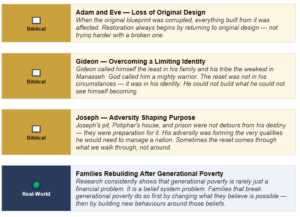
A reset begins when identity is restored. Psychology calls it a belief system. Scripture calls it renewing the mind. Practically, it is replacing old patterns with new habits until your life reflects your new identity.
“Your DNA is more than your biology. It is the blueprint of beliefs, habits, identities and expectations that have been passed down through families, cultures and experiences. God’s work of restoration is often a process of resetting the internal blueprint before changing the external results.”
1. Adam & Eve – Resetting the Original Design
Adam and Eve were created in God’s image (Genesis 1:26-28). Sin did not simply introduce bad behaviour—it corrupted humanity’s operating system.
After the Fall they immediately:
- Hid themselves.
- Felt shame.
- Blamed others.
- Worked from fear rather than relationship.
God’s plan of redemption through Christ restores mankind back to sonship and original purpose.
“If anyone is in Christ, he is a new creation.” (2 Corinthians 5:17)
The Gospel is God’s DNA reset.
Psychologists call this a core belief system.
When people experience trauma, rejection or failure they begin believing:
- I’m not enough.
- I don’t belong.
- I’ll never succeed.
- I’m unsafe.
Those beliefs become automatic filters through which every experience is interpreted.
Cognitive Behavioural Therapy (CBT) teaches that changing behaviour without changing core beliefs rarely lasts.
God works exactly the same way.
Romans 12:2
“Be transformed by the renewing of your mind.”
Transformation begins internally.
Ask yourself:
What lies have become my identity?
Then replace them with truth.
Instead of:
“I always fail.”
Replace with:
“I am learning.”
Instead of:
“My family has always been poor.”
Replace with
“My family history informs me, but it does not imprison me.”
2. Gideon – Resetting Identity
Judges 6
Gideon says:
“My clan is the weakest.”
“I am the least.”
Notice he introduces himself using inherited limitations.
God ignores every label.
Instead He says
“Mighty warrior.”
God speaks to potential before performance.
Identity always precedes assignment.
This is called self-schema.
A self-schema is the internal story people tell themselves.
“I am shy.”
“I am bad with money.”
“I’m unlucky.”
People behave consistently with the identity they believe.
Research repeatedly shows people unconsciously protect their identity—even when that identity is negative.
This is why people sabotage success.
Their life is trying to stay consistent with who they believe they are.
Stop introducing yourself by your limitations.
Instead ask:
Who does God say I am?
Every day begin reinforcing that identity.
Identity → Decisions → Habits → Results
Not the other way around.
3. Joseph – Resetting Through Adversity
Joseph’s DNA was not changed despite betrayal.
Every season prepared him.
Pit
↓
Slave
↓
Prison
↓
Palace
Each environment developed another leadership muscle.
God wasn’t delaying Joseph.
He was developing Joseph.
Romans 8:28
Modern psychology calls this Post-Traumatic Growth.
Some people merely recover from hardship.
Others become stronger because of hardship.
The difference isn’t the event.
It’s the interpretation.
Growth mindset asks
“What is this teaching me?”
Victim mindset asks
“Why me?”
Joseph consistently chose purpose over bitterness.
Instead of asking
“Why is this happening?”
Ask
“What capacity is God building in me?”
Every painful experience can produce:
- resilience
- empathy
- wisdom
- leadership
- patience
Pain becomes preparation when processed well.
4. Families Escaping Generational Poverty
Throughout Scripture, God repeatedly tells Israel
“Remember.”
Why?
Because slavery had shaped their thinking.
Although Israel left Egypt quickly,
Egypt took decades to leave Israel.
Many wanted to go back.
Their location changed faster than their mindset.
Generational poverty is often reinforced by:
- scarcity mindset
- learned helplessness
- low financial confidence
- delayed gratification difficulties
- limited exposure
- inherited beliefs
Psychologists refer to this as intergenerational transmission of beliefs and behaviours.
Children inherit more than money.
They inherit:
- attitudes
- expectations
- emotional responses
- financial habits
- relationship patterns
The encouraging reality is that these patterns are learned—which means they can also be unlearned.
Practical Reset
Families that build lasting wealth intentionally create new patterns.
Examples include:
- reading together
- budgeting every month
- investing before spending
- discussing business ideas
- celebrating learning
- teaching delayed gratification
- serving others
- building strong marriages
- planning inheritance and legacy
Every repeated habit rewrites the family’s future.
Your DNA Reset Framework
Beliefs
What do I believe to be true?
↓
Identity
Who do I believe I am?
↓
Decisions
What choices feel natural because of that identity?
↓
Habits
What do I repeatedly do?
↓
Destiny
What future am I creating?
Proverbs 23:7 captures this beautifully:
“For as he thinks in his heart, so is he.”
Closing Challenge
“Every family inherits a blueprint. Some inherit faith, others fear. Some inherit vision, others limitation. Some inherit wealth, others debt. The question is not what blueprint you received—it is whether you will intentionally pass the same blueprint to the next generation.
Jesus came not merely to forgive sin, but to restore original design. Psychology confirms that beliefs can be rewired. Neuroscience shows the brain can form new pathways through repeated thought and action. Scripture declares that the mind can be renewed. Together they point to the same truth: lasting transformation begins within.
Your family’s story does not have to end where it began. Someone has to become the reset point. Why not let that person be you?”
Part 3 — What Is In Your Hand?
After the reset comes the discovery. Before you can build anything significant, you have to know what you are building with.
Moses had a rod. David had a sling. The widow had oil. Bezalel had his hands and his craft. The Proverbs 31 woman had her skills, her time, and her relationships.
Every one of them was closer to provision than they realised. The question God keeps asking is the same one He asked Moses:

The Skill Inventory
A skill inventory is a simple but powerful exercise. Write down every skill you have — not just the ones you get paid for. Include:
• Things people regularly ask you for help with
• Things you do naturally that others find difficult
• Knowledge you have built up over years of experience
• Problems you have solved in your own life that others still face
• Creative abilities, technical abilities, relational abilities
Then ask: which of these skills solves a problem someone would pay to have solved? That is the beginning of your wealth creation strategy.
LESSON 4 REFLECTION
Take a few minutes to answer these questions honestly:
1. What financial or identity pattern did you inherit from your family that you want to break in your generation?
2. Is there a belief you carry about money, success, or your own potential that needs to be reset?
3. Do your skill inventory now — write down everything you carry. What is in your hand?
Write your answers in your journal or drop them in the Blueprint Actions and Wins category in the community.
YOUR NEXT STEP AFTER THIS LESSON
The identity reset and the skill inventory you just did are the exact foundation of Module 1 of the Abundant Life Blueprint.
The Abundant Life Blueprint takes you much deeper into identity, healing, and purpose —
covering the seven pillars that build the complete inner foundation of a wealth builder.
When you are ready: Classroom → The Abundant Life Blueprint → Module 1, Lesson 1.
When you have finished this lesson, click the Mark as Done button at the top right to track your progress and move to the next lesson!